
When parents think about a “good” preschool, academic learning often comes to mind first. Many parents want their children to learn the alphabet, numbers, writing, reading, and other foundational skills as early as possible. While these skills are important, an important question remains: Should young children be rushed into academics before they are developmentally ready?
Finland offers a different perspective.
Finnish early childhood education places strong emphasis on play, wellbeing, curiosity, exploration, social development, and learning through everyday experiences. Rather than treating preschool as an early version of primary school, the Finnish approach recognizes early childhood as a unique stage of development where children need opportunities to play, discover, communicate, move, create, and build confidence.
So, what can India learn from this approach?
The Finnish education system views early childhood education and care as an important foundation for lifelong learning. Its approach combines care, education, and teaching, with particular emphasis on children’s holistic development.
This means that learning does not only happen when a child is sitting at a desk with a worksheet.
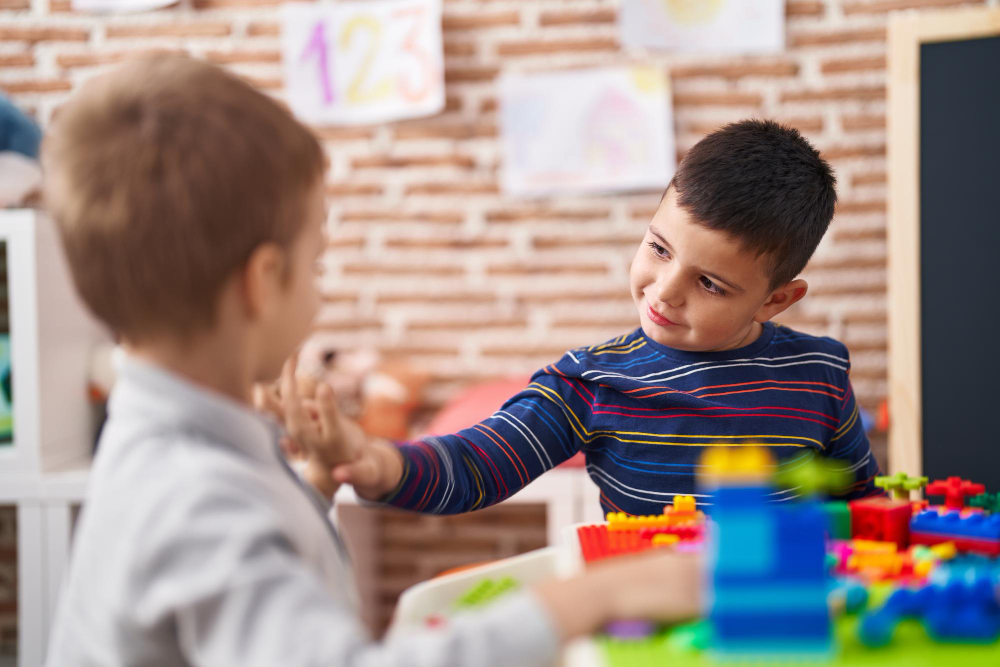
A child develops important skills while building with blocks, listening to a story, playing with friends, exploring nature, creating artwork, or solving a simple problem during play.
These experiences can support language development, communication, creativity, problem-solving, emotional regulation, motor skills, and social confidence.
Academic knowledge is therefore not ignored. Instead, it is introduced in ways that are meaningful and appropriate for young children.
One of the most recognizable features of Finnish early education is its emphasis on play.
The Finnish National Agency for Education describes play as essential to children’s wellbeing and learning. Children learn through exploring, experimenting, interacting with others, expressing themselves, and participating in playful activities.
Imagine teaching numbers through a worksheet versus counting toys during a game.
Both activities can introduce numeracy. But the second approach can make the learning more engaging and connected to the child’s experience.
Similarly, children can develop language skills through storytelling, songs, conversations, role-play, and picture books.
The objective is not simply to make learning easier. It is to make children want to learn.
There is a common misconception that a play-based preschool means children are not learning academic concepts.
That is not the case.
Finnish early childhood education includes areas such as language, mathematics, science, arts, physical education, and social-emotional development. The difference lies in how these areas are introduced.
Instead of placing academic achievement at the centre of the preschool experience, educators can integrate learning into meaningful activities.
A child might learn patterns while playing with blocks, practice counting during a game, develop vocabulary during storytime, or explore science through a nature activity.
This creates a balance between academic foundations and overall development.
Every child develops differently.
One child may begin speaking confidently early, while another may take more time. One may enjoy numbers, while another may be fascinated by drawing, movement, or stories.
A rigid academic environment can sometimes make children feel that they need to achieve the same milestones at exactly the same time.
The Finnish approach places greater emphasis on understanding the individual child and supporting their development. Finland’s current early childhood framework also emphasizes individual plans, children’s participation, supportive learning environments, and activities that encourage exploration and experimentation.
For parents in India, this is an important lesson: early education should support a child’s development rather than turn childhood into a race.
Knowing how to write the alphabet is useful. But so is knowing how to communicate, cooperate, manage emotions, make friends, ask questions, solve problems, and recover after making a mistake.
These are skills children will use throughout their lives.
Play provides opportunities for children to negotiate, collaborate, take turns, make decisions, experiment, and express themselves. Finnish early education therefore looks at the child as a whole rather than focusing exclusively on academic outcomes.
A confident child who enjoys learning is more likely to approach new challenges with curiosity rather than fear.
India has a diverse education system with different parental expectations, cultural contexts, and academic requirements. Therefore, the Finnish model should not simply be copied.
Instead, Indian preschools can adopt the principles behind it.
This can include:
Making play an important part of the daily learning experience
Encouraging curiosity instead of relying heavily on memorization
Giving children opportunities to explore and ask questions
Supporting social and emotional development
Connecting academic concepts with real-world experiences
Providing opportunities for outdoor play and physical activity
Respecting individual differences between children
Creating a safe and encouraging environment where children can make mistakes
The goal should be to create children who are not only school-ready but also life-ready.
This philosophy is at the heart of LILLIPODS.
Lillipods India, being one of the Best Preschool Franchise in India, brings Finnish-inspired early education together with local needs and expectations. Its approach focuses on play-led learning, whole-child development, curiosity, creativity, and emotional wellbeing.
At LILLIPODS preschools, children are introduced to areas such as language, numeracy, science and environment, physical education, arts and culture, and socio-emotional skills through engaging activities.
For example, numeracy can be explored through counting objects, shapes, patterns, puzzles, and games. Science can come alive through nature walks, water play, simple experiments, and observing how things grow.
This approach allows children to build academic foundations without making academics the entire preschool experience.
LILLIPODS also emphasizes teacher development and Finnish-inspired teaching principles, helping educators create learning environments where children can explore, participate, and develop with confidence.
The biggest lesson from Finnish early education is not that academics are unimportant.
It is that there is a right time, right method, and right environment for learning.
Young children are naturally curious. They want to discover how things work, ask questions, imitate adults, create stories, move, experiment, and play.
Preschool education can build on that natural curiosity instead of replacing it with excessive academic pressure.
For India, the opportunity is to create early learning environments where children can develop strong academic foundations while also becoming confident, creative, emotionally resilient, and curious learners.
Because the best preschool experience is not necessarily the one where children learn the most worksheets.
It is the one where children learn to love learning itself.
 Blog
Blog  24 August 2026